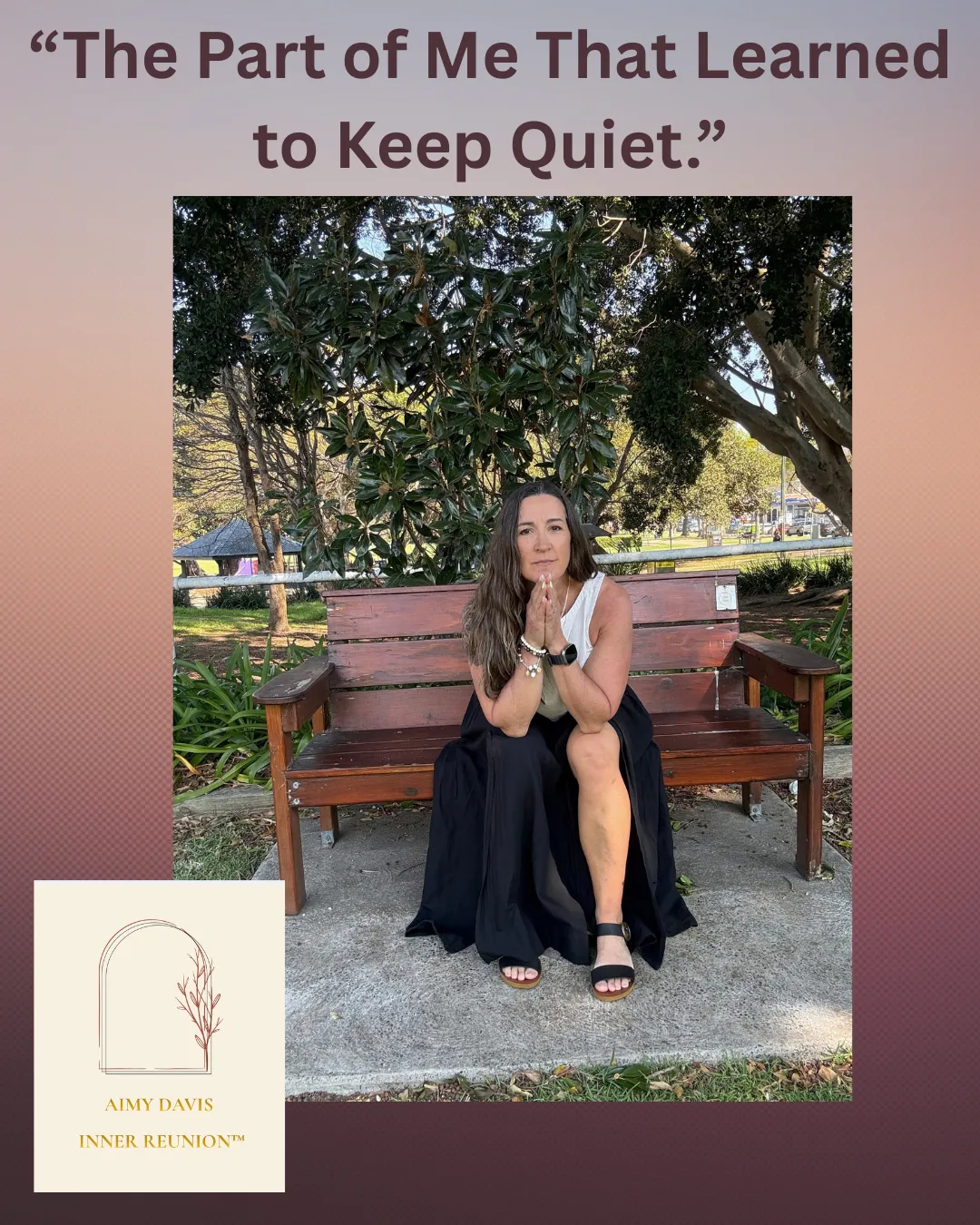
The Part of Me That Learned to Keep Quiet
The Part of Me That Learned to Keep Quiet
This morning I did something that, on the surface, probably didn't look particularly significant.
I spoke my truth.
I said what I needed to say to someone I love.
I said it with kindness. I said it with integrity. I wasn't trying to hurt, blame or attack. I simply needed to stop carrying something inside of me that I had been afraid to express.
And when I finally did, I noticed something.
There was a little part of me saying:
No, no, no. Don't say it. Just leave it.
I know that part well.
She's the part of me that learned a very long time ago that sometimes it felt safer to be quiet.
The good girl who kept the peace
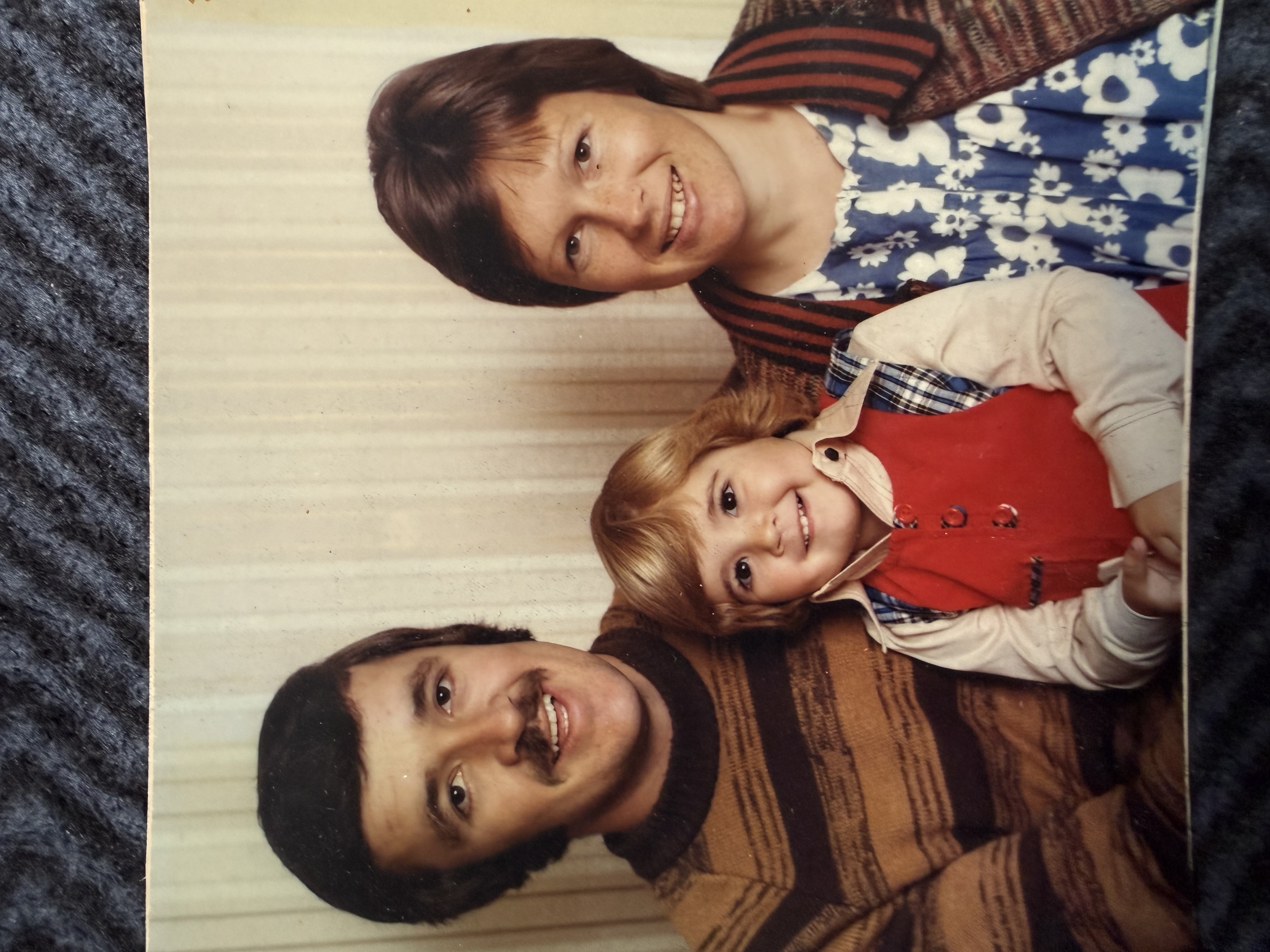
I've been reflecting a lot lately on the parts of ourselves that develop when we're young.
I'm the eldest child, and my mum experienced severe postnatal depression after I was born. I was loved and cared for, but there were things happening around me that, as a little girl, I couldn't possibly understand.
Then my sister came along and needed a lot of Mum's attention.
Somewhere amongst all of that, I learned to be the good girl.
Be quiet.
Don't make things harder.
Make sure everyone else is okay.
There's a story my mum has told me about a time when she was extremely stressed and lost her cool with me. Afterwards, she felt terrible.
And apparently little me turned around and comforted her.
"It's okay, Mummy. It's okay."
When I look at that story now through the work I do with parts, I can see so much more than a sweet little girl comforting her mum.
I can see the beginnings of a pattern.
Make sure everybody else is okay — even when you're the one who is hurting.
When staying quiet follows you into adulthood
That pattern didn't disappear when I grew up.
I struggled with boundaries.
If somebody upset me, I'd often gloss over it.
"No, it's fine."
If someone I loved did something that hurt me and then apologised, I'd quickly make everything okay again.
I trusted easily. Sometimes too easily.
And rather than risk upsetting somebody or creating conflict, I would hold things in.
The problem is, just because we don't say something doesn't mean it disappears.
We can park it on the shelf.
We can avoid the conversation.
We can tell ourselves we've moved on.
But sometimes we're still carrying it.
My throat had something to say
A few years ago I had my first one-on-one breathwork session.
I remember being incredibly nervous because I didn't really know what I was walking into.
During that session, so much came up around my throat.
The tightness.
The swallowing.
The feeling that something was blocked there.
For me, it felt deeply connected to everything I hadn't expressed.
And looking back now, I can see how much has changed since then.
Slowly, I've been learning to use my voice.
Not necessarily louder.
Not harsher.
Just more honestly.
And something I realised recently is that using my voice doesn't require me to stop being the kind-hearted person I am.
I don't have to choose between kindness and truth.
I can be kind and still speak.
I can love someone and still have boundaries.
I can speak with integrity without being responsible for how my words are received.
That last one has been a big lesson.
What belongs to me and what doesn't
When we finally speak about something we've been carrying, we can't control what happens at the other end.
Someone may understand.
They may not.
They may become defensive.
They may interpret our words through their own experiences, wounds and protective parts.
That belongs to them.
What belongs to me is how I show up.
Was I honest?
Was I respectful?
Did I speak from love rather than deliberately trying to wound?
Did I honour myself as well as the other person?
That's the part I can take responsibility for.
I don't need to abandon myself in an attempt to control somebody else's response.
And for the part of me that learned very young to make sure everybody else was okay, that's a pretty big shift.
The parts of us aren't the enemy
This is one of the reasons I love parts work so much.
The part of me that learned to stay quiet wasn't weak.
She was adapting.
At some point, staying quiet helped her feel safe, connected or loved.
So I don't need to get rid of her.
I can notice her.
I can listen to her.
I can understand why she's frightened.
And then the adult me can gently remind her:
It's okay. I've got this now.
I can choose when to speak.
I can choose how I speak.
And I can survive somebody not liking what I have to say.
Coming back to our natural expression
This is also where I find the intersection between psychology, energy and the different blueprints I work with so fascinating.
When I look at my own astrology and Human Design, communication and expression are significant themes for me.
And yet life experience taught a part of me to suppress some of that expression.
That's why I don't believe our patterns necessarily tell us who we are.
Sometimes they tell us how we learned to survive.
And perhaps part of coming home to ourselves is becoming curious about the difference.
What is genuinely me?
What did I learn to do to stay safe, loved or accepted?
What parts of myself have I pushed down?
And what might become available if I allowed those parts of me to have a voice again?
Because sometimes the thing we've spent years holding back is sitting right beside one of our greatest gifts.
I'm still learning this.
I'm still noticing the parts of me that get frightened when I speak, when I'm seen, when I put myself out there.
But I'm speaking anyway.
Not perfectly.
Not always eloquently.
But authentically.
And perhaps that's the point.
Finding your voice isn't necessarily about learning how to say everything perfectly.
Sometimes it's simply learning that you're allowed to speak at all.
